Lost File — Securinets CTF 2025
Challenge Scenario
"My friend told me to run this executable, but it turns out he just wanted to encrypt my precious file. And to make things worse, I don't even remember what password I used. 😥 Good thing I have this memory capture taken at a very convenient moment, right?"
Artifacts Provided:
- Disk image with
locker_sim.exeandto_encrypt.txt.enc. - Memory dump captured during the encryption process.
🔍 Initial Investigation
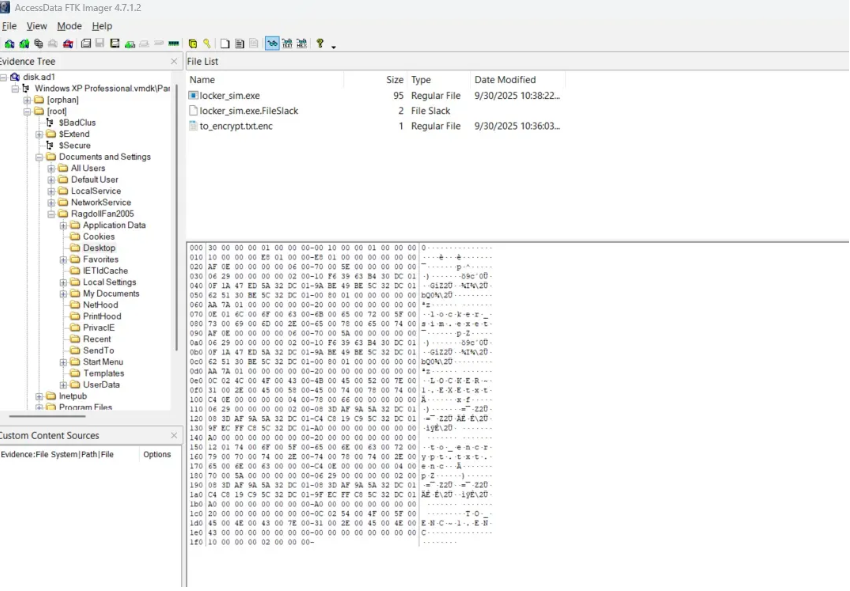
Discovering the Files
Examining the desktop environment, we identify the malicious binary and the encrypted payload.
Reverse Engineering the Executable
Using IDA Pro, we analyzed locker_sim.exe (written in C) to understand the encryption flow.
The encryption process works as follows:
- Takes a command-line argument (
argv[1]) as the primary password. - Reads the system's
COMPUTERNAMEfrom the registry. - Reads a local file called
secret_part.txt(and deletes it post-encryption). - Combines these:
password|HOSTNAME|secret_part_content. - Computes a SHA256 hash of this combined string.
- Uses the hash as the AES-256 key to encrypt the target file.
[!WARNING]
To decrypt, we MUST find:
- The original command-line password.
- The system hostname.
- The content of the deleted
secret_part.txt.
🧠 Memory Forensics with Volatility
Finding the Password
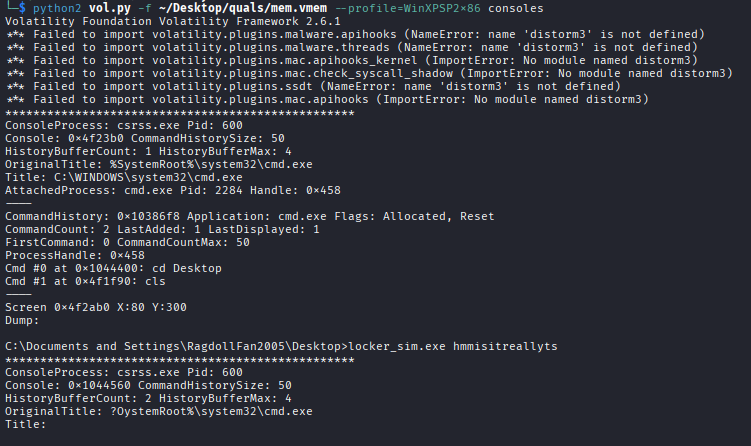
We use the consoles plugin to extract command history:
vol.py -f mem.vmem --profile=WinXPSP2x86 consoles
# Output: locker_sim.exe hmmisitreallyts
Password: hmmisitreallyts
Finding the Hostname
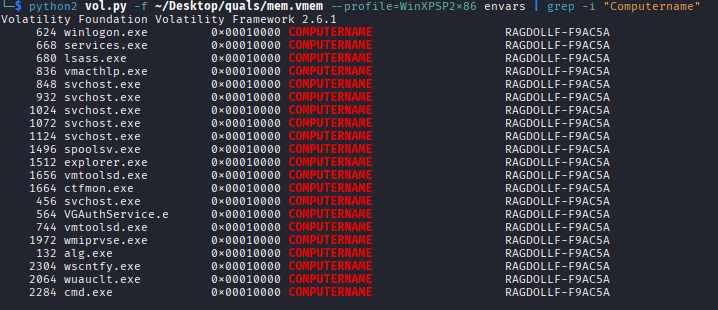
Using the envars plugin:
Hostname: RAGDOLLF-F9AC5A
Recovering the Deleted Secret
Since secret_part.txt was deleted, we checked the Recycle Bin metadata and recovered the content.
Secret Part: sigmadroid
🔓 Decryption & Flag Extraction
With all components recovered, we wrote a Python script to reconstruct the key and decrypt the file.
import hashlib
from Crypto.Cipher import AES

def decrypt(enc_path, password, hostname, secret):
    data = f"{password}|{hostname}|{secret}"
    key = hashlib.sha256(data.encode()).digest()
    iv = key[:16] # AES-CBC IV
    # ... decryption logic ...
Final Flag: Securinets{screen+registry+mft??}
(The flag hints at the forensics techniques used: screen capture/memory, registry analysis, and MFT for file recovery.)
🛠️ Tools & Techniques
- RE: IDA Pro
- Memory Forensics: Volatility Framework (
consoles,envars) - Disk Forensics: Recycle Bin Analysis, MFT artifact examination
- Crypto: Python/PyCryptodome (AES-256 CBC)